Your First Trail Run Will Feel Clumsy. Here Is Why That Is Normal
Tripping on roots and shuffling down hills on your first trail run? Here is the body mechanics behind why it feels clumsy, and why that awkwardness is normal.


The first time you run on a trail, your legs will feel like they forgot how to work. You trip on a root you saw coming. You slow to an awkward shuffle on the descents. A more experienced runner floats past while you pick your way down like the ground might bite. This is normal. Every trail runner started exactly here.
Road running rewards one smooth, repeatable stride. Trails do the opposite. The surface changes under every footfall, so your body has to learn a different way to move. Feeling clumsy is not proof that you are bad at this. It is proof that you are learning something new.
Your Body Is Running on Old Instructions
On pavement, you can almost run on autopilot. The ground is flat and predictable, so your brain stops paying attention and lets the same stride repeat thousands of times. Trails break that habit instantly. Roots, rocks, ruts, and loose dirt mean no two steps are ever the same.
That early clumsiness is simply your nervous system catching up. It is busy building new reflexes for reading terrain and adjusting in real time. Give it a few weeks of regular trail miles and the panic fades. The skills below will speed that up.
Look Ahead, Not at Your Feet
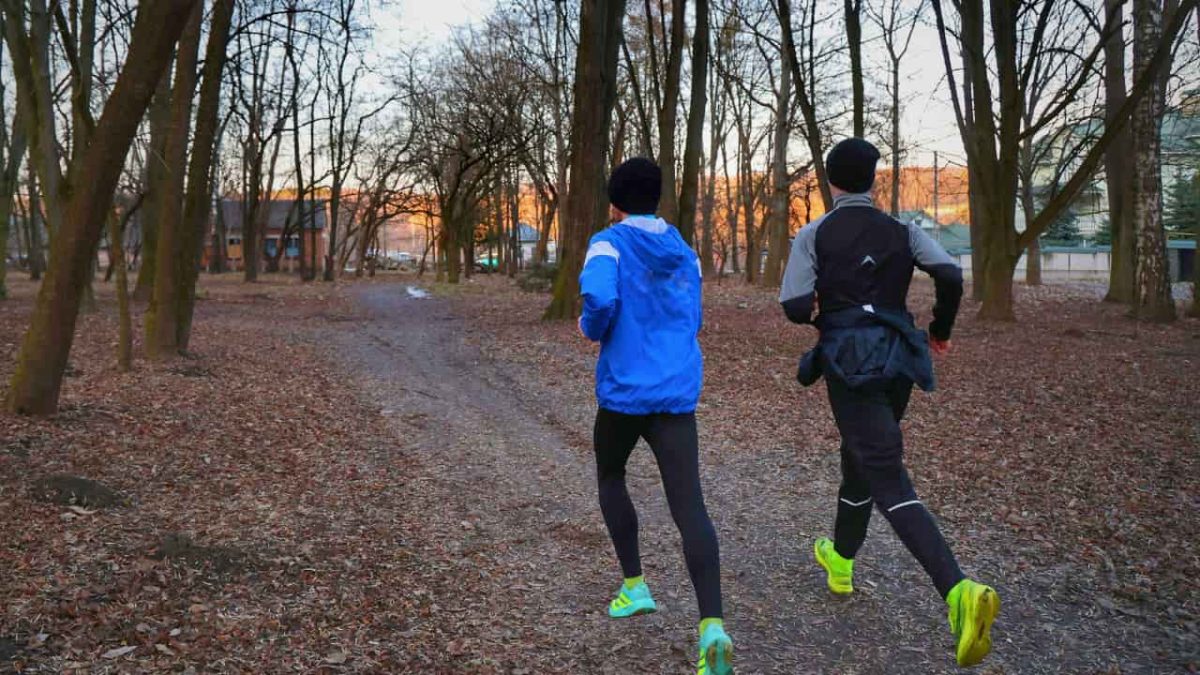
The single biggest beginner mistake is staring straight down at your shoes. It feels safe, but it is the reason you keep tripping. By the time an obstacle is directly under your feet, it is already too late to react.
Instead, keep your eyes roughly ten to fifteen feet ahead on the trail. Let your gaze scan the ground coming toward you, not the patch you are standing on. Your brain is remarkably good at remembering where a root was a second ago and quietly telling your feet what to do. Trust it.
This is often called soft eyes. You are not locking onto one thing. You are taking in the whole stretch of trail ahead and letting your feet sort out the details. It feels strange at first, and then it feels like a superpower.
Take Shorter, Quicker Steps
On the road, long strides are efficient. On trails, they are a liability. A long stride commits your weight to wherever your foot lands, and on uneven ground that is a gamble.
Shorten your steps and pick up your cadence. Quick, light steps keep your feet under your body, which is where you have the most control. They also give you more chances to adjust. If one step lands badly, the next correction is only a fraction of a second away.
Think small and frequent rather than long and powerful. You will feel less like you are bounding and more like you are dancing across the surface. That nimble feeling is exactly what you are after.
Land Light and Let Your Feet React
You do not need to plan every footfall. You cannot, and trying to will only exhaust you. Instead, land softly and stay ready to adjust.
Keep your knees slightly bent and your ankles loose so your feet can roll, tilt, and reposition the instant they touch down. A stiff leg slamming onto a rock has nowhere to go. A relaxed, springy leg absorbs the surprise and moves on. Quiet feet are a sign you are doing it right.
Roots and Rocks Are Not the Enemy
Beginners treat every root like a tripwire. The trick is to stop avoiding obstacles and start using them. A flat rock or a solid root can be a perfectly good place to plant a foot, often better than the loose dirt around it.
When you can, step over obstacles rather than onto the edge of them. When you do step on one, aim for the top center, where it is most stable. And when something looks gnarly, it is completely fine to take a tiny hop or a quick walk through it. Smooth beats fast every single time.
Descents Are Where Everyone Tenses Up
Downhills are the scariest part for new trail runners, and the instinct is to lean back and brake hard. That backward lean actually makes you slip more, because it pushes your feet out from under you.
Try the opposite. Lean very slightly forward from the ankles, keep those steps short and quick, and let gravity do some of the work. Stay low with soft knees so you can absorb whatever comes. It feels counterintuitive to lean into a downhill, but a controlled forward lean keeps your weight over your feet where it belongs.
If a descent is steep or sketchy, slow to a walk without shame. Even seasoned runners hike the technical drops. Speed on descents comes from confidence, and confidence comes from reps.
Stay Loose From Head to Toe
Tension is the enemy of good trail movement. When you are nervous, your shoulders creep up, your arms clamp in, and your stride goes rigid. That rigidity is what makes you stumble.
Let your arms swing a little wider than usual. They are your balance system, and you will instinctively throw them out to steady yourself on uneven ground. Drop your shoulders, unclench your jaw, and breathe. A loose body reacts. A tight body fights.
Give It Time
Here is the part nobody says clearly enough. The clumsiness goes away. Not because the trail gets easier, but because you get better at reading it. The same roots and rocks that feel like a minefield today will feel like a rhythm in a month.
Every awkward, stuttering, slightly nervous run is building the exact skills that make trail running feel effortless later. You are not behind. You are right on schedule. Keep showing up, look ahead, stay light, and let your body learn the language of the trail run.